
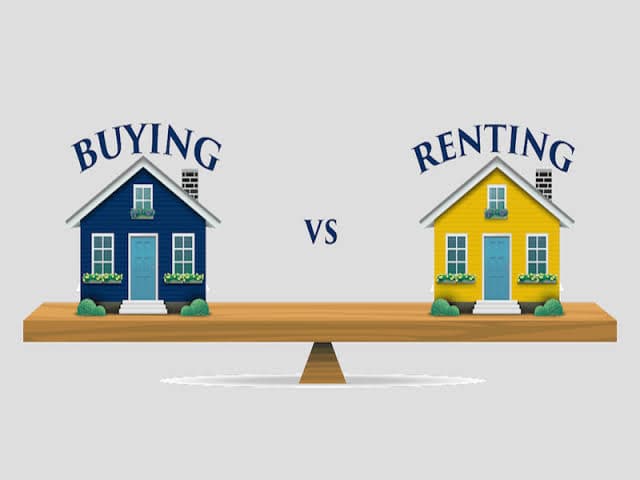
For generations, owning a home has been treated as one of the clearest signs of financial progress. Get a stable income, buy land, build a house or take a mortgage, and eventually stop paying rent.
There is good reason for that thinking. A home can provide security, stability and an asset that may appreciate over time. Mortgage repayments can gradually build equity, and an owner eventually has the possibility of living without either rent or mortgage payments.
But the financial decision between renting and owning is more complicated than the popular phrase that paying rent is "throwing money away."
Rent pays for something valuable: the right to live in a property without committing the enormous amount of capital required to purchase it. For some people, particularly younger professionals, entrepreneurs and people whose careers may require them to relocate, that flexibility can have considerable financial value.
The cost of buying goes beyond the house price
Suppose someone wants to live in a neighbourhood where purchasing a suitable apartment requires several million shillings.
The alternative may be renting a similar property for a fraction of the purchase price each year. Buying requires either substantial savings or financing, and a mortgage introduces interest payments that can considerably increase the eventual cost of the property.
Kenya's borrowing environment makes this especially relevant. Central Bank of Kenya indicators show the average commercial bank lending rate stood at 14.39 per cent in July 2026. Mortgage pricing varies between lenders and borrowers, but relatively expensive credit can significantly alter the economics of purchasing a house.
Buying also involves expenses beyond the advertised property price. Buyers may encounter valuation costs, legal fees, stamp duty, registration charges, insurance and other transaction expenses.
Once the keys are handed over, the costs do not disappear.
The homeowner becomes responsible for maintenance and repairs. Apartments and properties in managed developments can attract service charges, while houses periodically require spending on plumbing, painting, roofing, electrical systems, security and other maintenance.
Renters generally transfer much of the responsibility for major structural expenses to the property owner.
Property is an investment, but so is the money used to buy it
One of the strongest arguments for homeownership is that property can appreciate.
Kenyan residential property prices are indeed rising. The Kenya National Bureau of Statistics' Residential Property Price Index showed average residential property prices increased 4.8 per cent between the first quarter of 2025 and the first quarter of 2026.
But appreciation should not be considered in isolation.
Imagine having Sh3 million available for a deposit on a home. Once that money is committed to property, it cannot simultaneously be invested elsewhere.
This is known as opportunity cost.
The renter may instead keep some or all of that capital invested in other assets while continuing to rent. Depending on investment performance, the difference can become substantial over many years.
This is where the rent-versus-buy debate becomes more interesting.
The comparison is not simply:
Rent versus mortgage payment.
It is:
Rent plus invested capital versus the total cost of ownership plus the equity and appreciation generated by the property.
That calculation can produce very different answers depending on the property, financing costs, rent, investment returns and how long someone intends to live there.
Renting only works financially if you use the difference wisely
There is an important catch.
Renting does not automatically make someone wealthier.
Consider two people earning similar incomes. One buys a house and spends a significant part of their income servicing the mortgage. The other rents a cheaper property but spends every shilling saved through renting on lifestyle expenses.
After 15 or 20 years, the homeowner may have accumulated substantial property equity while the renter has little to show for the difference.
Now change the scenario.
The renter consistently invests the deposit they did not use to purchase a house and invests part of the monthly difference between rent and the total cost of ownership.
The comparison becomes much closer.
This is why renting can be a strategy, but only when accompanied by financial discipline. Cheap rent followed by expensive consumption is not an investment strategy.
Flexibility has economic value
Homeownership also anchors capital to a particular location.
That may be exactly what someone wants when raising a family, establishing roots in a community or planning to remain somewhere for decades.
For someone at a different stage of life, however, mobility can be valuable.
A professional offered a better job in another county can relocate relatively easily when renting. An entrepreneur can move closer to a growing business. Someone working remotely can choose a cheaper town instead of remaining near an expensive commercial centre.
A homeowner can still move, of course, but selling property takes time and involves transaction costs. Alternatively, the owner must become a landlord and manage the property.
Renting effectively purchases mobility.
For people whose income, family circumstances or location could change significantly over the next few years, that flexibility should be included in the financial calculation.
Kenya remains overwhelmingly a rental market in urban areas
The debate is particularly relevant in Kenya because renting is already a normal part of urban life rather than an unusual temporary arrangement.
BuyRentKenya's 2025 property index, citing KNBS data, reported that roughly 73 per cent of urban residents rent their homes while about 23 per cent own them.
Formal mortgage penetration also remains relatively low. Recent discussions around housing finance have highlighted affordability, interest rates, deposits and access to long-term financing as barriers preventing many households from purchasing homes.
The situation is gradually changing. Kenya Mortgage Refinance Company has reported increasing uptake as lenders introduce longer-term and more affordable mortgage products, while government-backed affordable housing initiatives are also attempting to provide alternative routes to ownership.
This means the financial equation could continue changing as financing becomes more accessible.
Ownership still has powerful advantages
None of this makes homeownership a poor financial decision.
Owning provides something renting cannot fully replicate: permanent control over where you live.
There is no landlord deciding not to renew a lease, unexpectedly increasing rent or selling the property. Owners can renovate their homes, make long-term improvements and establish permanent roots.
A fully paid-off home can also dramatically reduce housing expenses later in life.
Perhaps most importantly, mortgages impose a form of forced saving. Every repayment that reduces the principal increases the owner's equity. Someone who struggles to consistently invest voluntarily may therefore accumulate considerably more wealth through homeownership than through renting.
Property can also be inherited, rented out, used as collateral in some circumstances or sold to release capital.
The correct argument is therefore not that renting is superior to ownership.
It is that ownership is not automatically superior to renting in every financial situation.
The real question is what happens to your money
Someone paying Sh40,000 in rent while investing Sh100,000 every month is in a completely different financial position from someone paying Sh40,000 in rent and saving nothing.
Likewise, someone buying an affordable property with manageable financing is in a different position from someone committing most of their income to an expensive mortgage simply because society says successful adults must own homes.
The house itself is only one part of the financial picture.
Income stability, mortgage rates, rent, property prices, investment returns, maintenance costs, family plans and expected length of stay all matter.
For someone who knows where they want to settle, can comfortably afford the property and intends to remain there for many years, buying can make considerable financial and personal sense.
For someone building a business, pursuing career opportunities, expecting to relocate or facing a large gap between local rents and property prices, renting and investing the difference may be the more flexible approach.
There is therefore no universal age at which someone must become a homeowner.
The better question is whether buying a particular property, at a particular price, with a particular financing arrangement, advances your financial goals more effectively than renting the same lifestyle and putting your capital to work elsewhere.
Sometimes the answer will be ownership.
Sometimes it will be renting.
What matters is that the decision is based on the numbers rather than the assumption that one is always financially superior to the other.