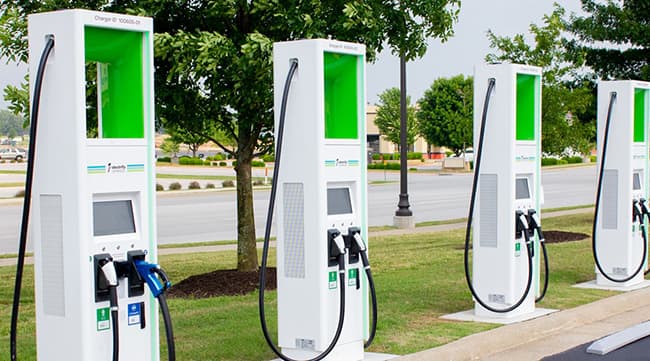
Kenya had the second-highest number of electric vehicle charging stations in Africa in 2025, highlighting the rapid expansion of the country's electric mobility industry as businesses and government agencies invest in infrastructure needed to support the transition away from petrol and diesel vehicles.
A survey by the United Nations Economic Commission for Africa found that Kenya had 235 EV charging stations, placing it behind only Egypt, which had 300. The gap between the continent's leading markets and much of Africa remains significant, with more than 25 countries having no EV charging station recorded in the survey.
Kenya's position has largely been supported by private investment, particularly in Nairobi and surrounding towns. Companies operating electric buses, motorcycles and other vehicles have increasingly built charging and battery-swapping infrastructure to support their fleets, while Kenya Power has also expanded its presence in the sector.
BasiGo, Roam, Ampersand and Kiira EV are among companies identified as contributing to charging infrastructure development. BasiGo has also partnered with Rubis Energy Kenya to install fast-charging facilities at selected service stations, including a facility at Sabaki along Mombasa Road.
Kenya Power has been expanding its own charging infrastructure as electricity demand from electric transport rises. The utility reported in June 2026 that cumulative revenue from electricity supplied for EV charging had reached Sh382 million between July 2023 and April 2026. Monthly revenue increased from less than Sh1 million in July 2023 to a peak of Sh35.25 million in February 2026, demonstrating how quickly electricity consumption from the sector is growing.
The expansion follows a sharp increase in EV electricity consumption during 2025. Kenya Power recorded approximately 8.43 million kilowatt-hours of electricity consumed by the e-mobility sector during the year, representing a 188 percent increase from 2.92 million kWh in 2024.
The growth is also visible on Kenyan roads. National Transport and Safety Authority data cited in the UNECA report showed the country had 35,661 electric vehicles, although motorcycles accounted for the overwhelming majority at 33,374. The fleet also included 829 four-wheel motor vehicles, with three-wheelers making up the remainder.
Electric motorcycles have emerged as an important part of Kenya's transition because of the country's large boda boda industry. Operators can potentially reduce fuel and maintenance expenses by moving from internal-combustion motorcycles to electric alternatives, while battery-swapping networks allow riders to exchange depleted batteries rather than waiting for conventional charging.
Kenya's electricity mix could provide another advantage as adoption increases. Much of the country's electricity generation comes from renewable sources, particularly geothermal, hydro, wind and solar, strengthening the environmental argument for electrifying transport.
Government policy has also increasingly supported the sector. Kenya introduced a dedicated e-mobility electricity tariff in April 2023, providing a specific electricity pricing structure for EV charging. EPRA has additionally developed guidelines covering public charging stations and battery-swapping infrastructure.
The regulatory framework envisages a much larger national charging network. Guidelines provide for charging infrastructure along major highways and establish requirements covering issues such as safety, accessibility, payment methods, metering and the pricing of public charging services.
Despite the progress, access to charging infrastructure remains uneven. Much of Kenya's network is concentrated around Nairobi and other major urban areas, making longer journeys more difficult for drivers who need reliable charging facilities outside the capital.
Expanding the network along major transport corridors will therefore be critical if electric cars are to become practical for more motorists. Charging infrastructure will also need to grow in towns outside Nairobi as electric buses, commercial vehicles and private EVs become more common.
The country's EV market is already moving quickly. Kenya Power had onboarded 205 customers to its dedicated e-mobility electricity tariff by the end of 2025, while the utility has continued identifying additional customers using electricity for EV charging so they can transition to the specialised tariff.
Across Africa, Kenya is emerging alongside countries such as Egypt, Ethiopia and Rwanda as an early leader in electric mobility infrastructure. Ethiopia had about 100 charging stations in 2025, while Rwanda had 40, according to the UNECA survey.
For Kenya, the challenge is now moving beyond an early network concentrated around Nairobi towards infrastructure capable of supporting electric transport nationally.
With more electric motorcycles, buses, three-wheelers and cars entering the market, charging stations are becoming an increasingly important part of the country's transport infrastructure. Kenya's second-place continental ranking shows that the foundation is already being built, but the next phase will depend on how quickly that network reaches highways, regional towns and communities beyond the capital.