
For decades, becoming the chief executive of a technology company usually required more than having a good idea. Founders needed capital, technical employees, designers, marketers, administrators and infrastructure before they could transform an idea into a functioning business.
Artificial intelligence is beginning to dismantle some of those barriers, creating a new generation of entrepreneurs who can build far more before hiring the teams that would traditionally have been required.
They could be described as the AI-made CEOs. They are not chief executives created by artificial intelligence in the literal sense, nor are they people whose businesses operate without human judgement. They are founders whose ability to start, build and operate companies has been dramatically expanded by AI, allowing individuals with ambition and domain knowledge to execute at a scale that would previously have required considerably more money, specialised expertise and employees.
The shift is already becoming visible across the startup economy. Research published in the Harvard Business Review in 2026 described what it called a second great compression of entrepreneurship, in which the time, capital and headcount required to develop products, test ideas and build companies are falling as agentic AI becomes more capable. The researchers found examples of AI-native startups operating with product teams dramatically smaller than the conventional groups of engineers, designers, researchers and managers traditionally required to build software businesses.
This does not mean AI has made entrepreneurship easy. Customers still need convincing, businesses still need revenue, products still fail and founders still make costly mistakes. What has changed is the amount of execution that can take place between having an idea and needing a large organisation to support it.
A founder can now begin the morning discussing product architecture with an AI coding agent, analyse a business proposal before lunch, generate marketing concepts in the afternoon and review customer research later in the evening. The same person can use different AI systems to assist with software engineering, financial modelling, market research, copywriting, quality assurance and business strategy without employing a specialist for every individual function.
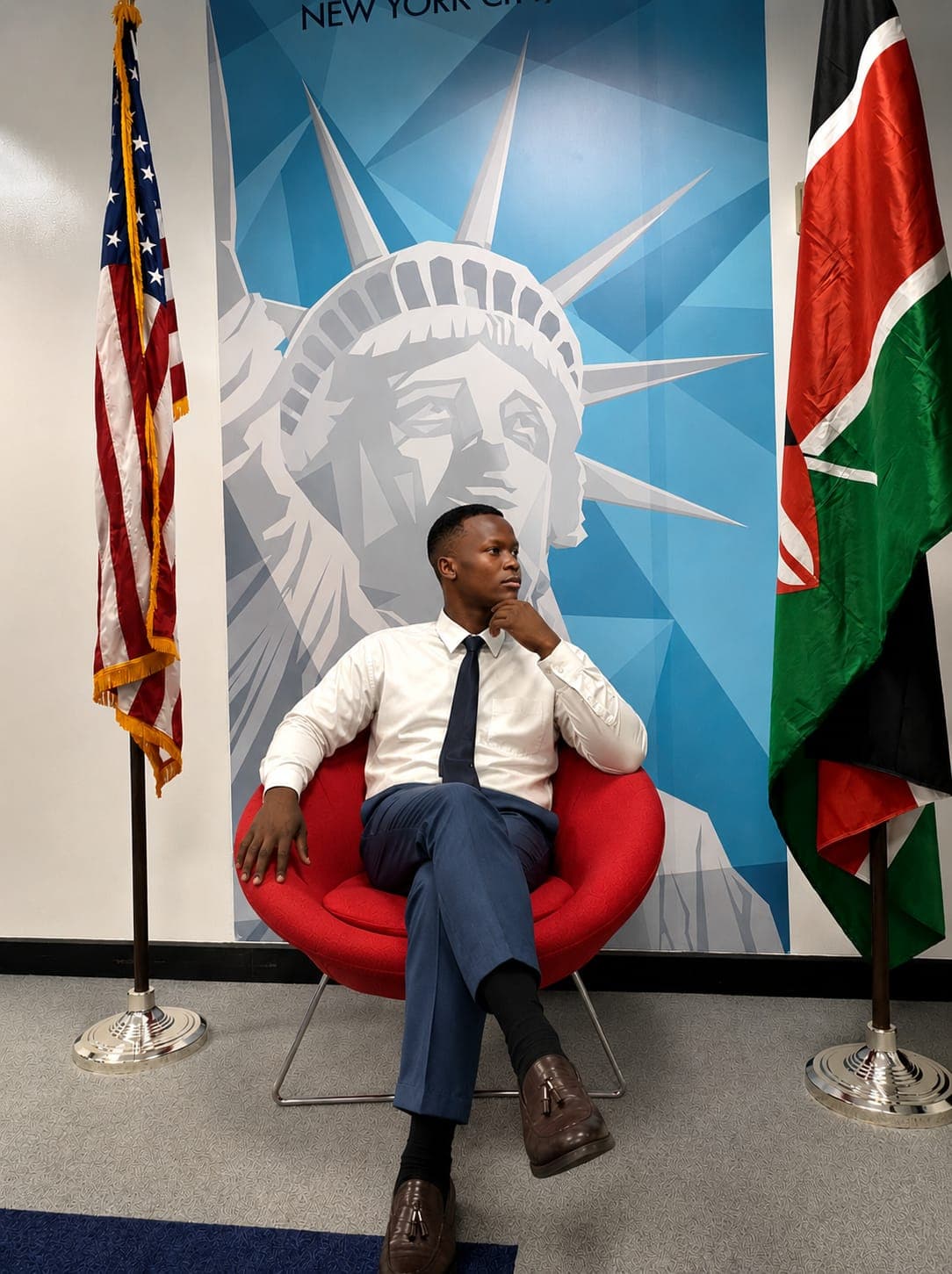
Peter William, founder and CEO of Kenyan technology company Datapyre Technologies Limited, provides one example of what this emerging model can look like. William's public work spans software development and technology publishing, while his writing on Datapoint Daily has explored tools such as Claude Code and the changing role of AI in software engineering. His path illustrates how entrepreneurs can increasingly combine their own skills with artificial intelligence to operate across disciplines that were once difficult for a single founder to manage simultaneously.
The significance is not that AI magically turned someone into a CEO. A title can be created in minutes by registering a company, but building a company that customers are willing to pay requires execution. The more important change is that AI has increased how much execution a determined individual can attempt before financial resources and team size become limiting factors.
Software development is one of the clearest examples. Building a serious digital product traditionally meant either learning programming deeply, finding a technical co-founder or paying developers. Even founders who could code faced the physical limitation of how quickly one person could design architecture, write features, debug applications, build databases, test systems and maintain infrastructure.
Modern coding agents are changing that equation. They can inspect large codebases, generate and modify multiple files, interact with development environments, identify bugs, write tests and help developers reason through architecture. The human founder remains responsible for deciding what should be built and whether the result is acceptable, but the amount of implementation that can happen within a given period has increased substantially.
That difference matters particularly in countries such as Kenya, where access to startup capital can determine whether promising ideas ever become functioning products. A founder who needs several million shillings simply to assemble a development and operational team faces a very different starting point from one who can build and validate much of the first product independently before raising significant capital.
AI therefore changes more than productivity. It can change the economics of becoming an entrepreneur.
The traditional startup often raised money partly because people were expensive. Engineers needed salaries, designers needed salaries, marketers needed salaries and administrative teams needed salaries long before a company became profitable. If AI allows a small founding team to perform some of that work, businesses can potentially reach customers with lower initial operating costs.
That does not mean companies will stop hiring people. Successful businesses eventually encounter problems that require experience, accountability, relationships and specialised human expertise. What may change is when those employees are hired and what they are hired to do.
Instead of building a 30-person organisation because 30 people are required to execute the work, an AI-native founder may initially build a much smaller organisation in which people supervise technology capable of handling substantial portions of repetitive or technical execution. As revenue grows, the company can then hire strategically rather than simply increasing headcount whenever workload increases.
This could fundamentally alter what it means to be a small business. Historically, the size of a company's workforce provided a rough indication of its operational capacity. A company with five employees simply could not perform as much work as one employing 100 people in most industries. Software, automation and AI are weakening that relationship.
The same transformation can be seen in marketing. A young business once needed separate expertise for graphic design, advertising, market research, copywriting, analytics and content production. AI cannot replace all of those skills at professional levels, but it can give one competent operator enough assistance to perform meaningful work across several of them.
Research is undergoing a similar transformation. Founders can interrogate large quantities of information, compare competitors, examine documentation and explore unfamiliar industries faster than before. The advantage does not come from blindly accepting AI answers, which can still be inaccurate, but from dramatically accelerating the process of finding questions, testing assumptions and organising information.
That introduces an important characteristic of the AI-made CEO: the ability to direct may become more valuable than the ability to personally execute every task.
A founder does not necessarily need to be the company's best programmer, designer, researcher and writer simultaneously. Instead, the founder increasingly needs enough understanding of those disciplines to describe the desired outcome, evaluate the work produced and recognise when something is wrong.
The distinction is similar to the evolution of traditional chief executives. The CEO of a large construction company does not personally lay every brick, while the head of an airline does not fly every aircraft. Their job is to coordinate people, capital and systems towards an objective. AI gives much smaller entrepreneurs access to a primitive version of that organisational leverage far earlier in the life of a company.
There are significant risks. A founder who depends heavily on AI without understanding the output can create insecure software, inaccurate financial assumptions, poor marketing or products built around problems customers do not actually have. Artificial intelligence can multiply bad judgement almost as efficiently as it multiplies good execution.
The technology also cannot manufacture entrepreneurial fundamentals. It cannot force customers to buy something they do not want, create trust where none exists or guarantee that a business model will become profitable. A founder still has to understand the market, make decisions under uncertainty, build relationships and accept responsibility when things go wrong.
Perhaps the greatest danger is confusing the ability to build quickly with the ability to build something valuable. AI has made software creation dramatically more accessible, which also means competitors can reproduce ordinary ideas faster. As technical execution becomes cheaper, understanding customers, distribution, reputation and business strategy may become more important rather than less important.
The emerging generation of AI-assisted founders will therefore be tested not by how much content or code they can generate, but by whether they can turn that extraordinary productive capacity into sustainable companies.
For African entrepreneurs, the opportunity could be particularly significant. The continent has no shortage of problems capable of supporting valuable businesses, from education and healthcare to payments, agriculture, logistics and public administration. What entrepreneurs have frequently lacked is inexpensive access to the technical and operational capacity required to test solutions at speed.
AI cannot solve the financing, infrastructure and regulatory challenges surrounding African entrepreneurship, but it can lower one barrier that has historically been expensive: access to specialised productive capability.
A founder sitting in Nairobi, Nakuru, Lagos or Kigali can now access AI systems built using billions of dollars of computing infrastructure and research. The entrepreneur does not own that infrastructure, but can temporarily access capabilities that would have been unimaginable for a small company only a few years ago.
That creates an unusual moment in business history. The distance between an ambitious individual and a functioning company is becoming shorter, while the amount of economic output a small team can potentially produce is increasing.
Peter William and other founders building companies during this transition belong to a generation that will discover what happens when entrepreneurship meets machine-scale assistance. Some of those businesses will fail, others will remain small, and a few may grow into organisations that would have required dramatically more people and capital in an earlier era.
The defining advantage will not simply be access to AI because eventually almost everyone will have access to similar technology. The advantage will belong to entrepreneurs who know what to build, understand the people they are building it for and learn how to coordinate machines and humans effectively enough to turn ideas into economic value.
The previous generation of CEOs built organisations primarily by assembling people. The emerging generation will increasingly build them by assembling people, software and intelligent agents into a single operating system.
AI is not replacing the entrepreneur. It is giving the entrepreneur leverage that was once available only to organisations.