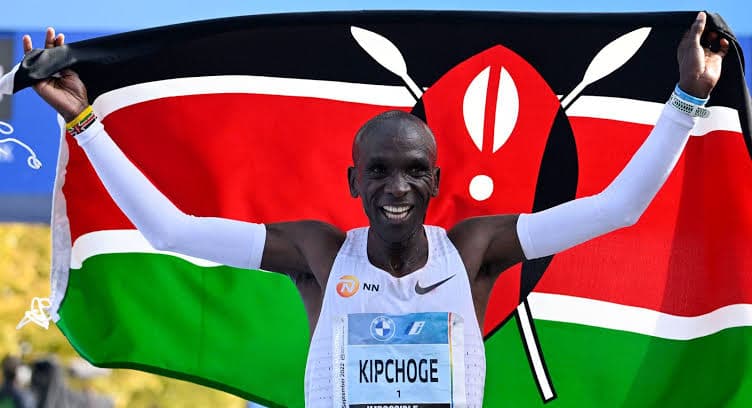
Kenyan marathon legend Eliud Kipchoge has delivered another memorable chapter in his extraordinary athletics career after winning the 2026 Melbourne Marathon in Australia, ending a three-year wait for victory and setting a new course record.
The 41-year-old two-time Olympic champion completed the race in two hours, nine minutes and 10 seconds on Sunday, October 11, producing a commanding performance that reaffirmed his ability to compete at an elite level despite being in the later stages of his professional career.
The victory was particularly significant because Kipchoge had endured a difficult period following years of dominance in international marathon running.
Once almost unbeatable over the 42.195-kilometre distance, the former world record holder had experienced several disappointing results as younger athletes increasingly challenged the established generation of marathon champions.
His Melbourne performance provided a reminder that experience, tactical discipline and physical preparation remain valuable assets in long-distance running.
Kipchoge controlled the race before making a decisive acceleration around the 30-kilometre mark, opening a gap over his closest challengers and maintaining his advantage through the final stages.
The Kenyan later explained that he had deliberately increased his pace after 30 kilometres to assess whether he could sustain a faster finish and challenge the existing course record.
His strategy proved successful as he crossed the finish line at the Melbourne Cricket Ground, celebrating before spectators who had gathered to witness one of the most recognisable figures in global athletics.
Australian runner Thomas Do Canto finished second in 2:10:35, while compatriot Reece Edwards completed the podium in 2:14:13.
The women's race was won by Australia's Camille French, who clocked 2:28:25. Sinead Diver finished second in 2:28:49, followed by Ireland's Nichola Sheridan in third place with a time of 2:29:13.
Kipchoge's victory came during a period in which he has been participating in marathon events across different continents, combining competition with a broader mission to promote running and connect communities through sport.
Melbourne represented another stop in that international journey, following appearances in Cape Town, South Africa, and Porto Alegre, Brazil.
The Australian event attracted more than 20,000 participants, creating an atmosphere that Kipchoge described as particularly motivating.
The Kenyan praised the enthusiasm of spectators and said the support he received throughout the race contributed to the experience.
His latest performance also places him among a distinguished group of Kenyan distance runners who have continued competing successfully well beyond the age traditionally associated with peak athletic performance.
Athletes such as Edna Kiplagat and Mark Kiptoo have demonstrated that elite distance-running careers can extend into an athlete's forties and beyond, provided they maintain the physical condition and discipline required for international competition.
Kipchoge's achievement adds another example to that tradition of longevity.
At 41, the former world record holder is competing against athletes who grew up watching him dominate major international races.
His career has included Olympic marathon victories at Rio 2016 and Tokyo 2020, as well as multiple triumphs in some of the world's most prestigious marathon events.
He also became the first person to complete the marathon distance in under two hours during a specially organised event in Vienna in 2019, although the performance was not eligible for official world record recognition because of the controlled conditions.
Those achievements established Kipchoge as one of the most influential figures in distance-running history.
However, his Melbourne victory demonstrates that he remains interested in more than celebrating past accomplishments.
Speaking after the race, Kipchoge expressed confidence in his physical condition and said he still possessed the strength and motivation to compete against younger runners.
The result could also provide renewed confidence as he continues his international marathon programme.
While the Melbourne winning time was slower than the performances that characterised his peak years, it was sufficient to secure victory and establish a new benchmark for the course.
The achievement is therefore best understood in the context of longevity rather than as evidence that Kipchoge has returned to the absolute peak of his career.
His ability to adapt to changing competitive circumstances and continue performing at a high level remains a significant part of his sporting legacy.
For Kenyan athletics, the victory provides another moment of celebration for a runner whose achievements have inspired generations of athletes.
It also reinforces the importance of patience, preparation and resilience in a sport where success depends on years of consistent training.
Three years after his previous marathon victory, Kipchoge has demonstrated that his competitive journey is not yet over. His record-breaking performance in Melbourne adds another milestone to a remarkable career and strengthens his place among the enduring legends of global distance running.