
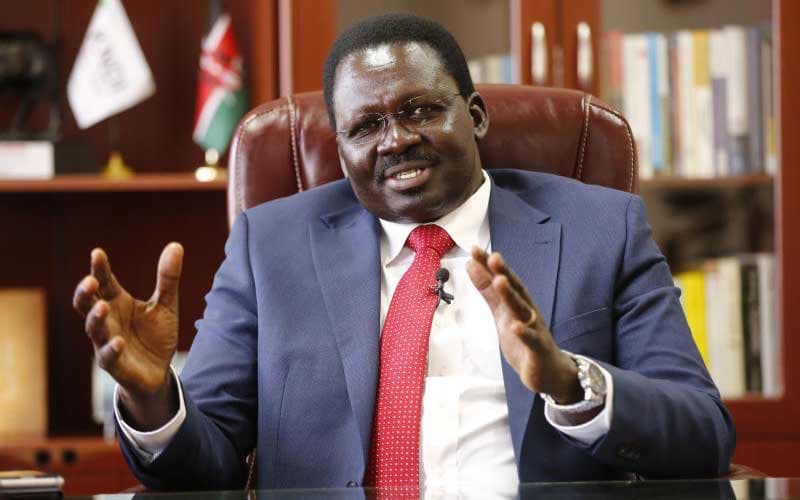
Prof. Henry Kiptiony Kiplangat's career tells the story of an educator who has steadily risen through Kenya's education sector, leaving a record of leadership at every stage of the journey.
Today, he serves as Vice-Chancellor of Kabarak University, but his association with educational leadership stretches back decades and includes remarkable periods at both secondary school and university level.

Before taking charge of a university, Kiplangat had already established his reputation as a school administrator. He served as principal of Sacho High School between 1995 and 2001. During his six-year tenure, Sacho High School rose from position 126 nationally to eighth in the KCSE examinations.
His next assignment brought him even closer to the institution he would eventually lead. Kiplangat became principal of Moi High School Kabarak in 2001 and remained there until 2015.
Under his leadership, Moi High School Kabarak attained first position nationally in the 2012 KCSE examinations. His contribution to secondary education was further recognised when he received the Principal of the Year Award in 2013.
Those achievements established Kiplangat as an accomplished education administrator, but another chapter of his career was already taking shape.
He had been associated with Kabarak University since its establishment in 2002 as a founding member of the University Council. In May 2015, he joined the university's senior management as Deputy Vice-Chancellor for Administration and Finance.
Kiplangat became Acting Vice-Chancellor in January 2017 before formally assuming office as Vice-Chancellor in December of the same year.
At the helm of Kabarak University, he has helped steer an institution that now offers programmes across fields including medicine and health sciences, law, pharmacy, business, education, science, engineering, technology, music and media.
His story, however, extends beyond executive offices. Prof. Kiplangat is also a scholar and author. He holds a Bachelor of Education from Kenyatta University, a Master's degree in Education from Lancaster University in the United Kingdom and a PhD in Educational Administration and Planning from the Catholic University of Eastern Africa.
His academic interests naturally mirror the world in which he has spent his career, particularly educational administration, leadership, planning and university management.
Among his scholarly works is University Management Practices and Academic Staff Job Satisfaction: Perspectives from Kenya, which examines management practices within universities and their relationship with the experiences and satisfaction of academic staff.

He also authored Headteachers' Response to the "Marketing Concept": Schools in England and Reflections on Kenya's Educational System, adding to a body of scholarship centred on educational leadership and institutional management.
His Kabarak academic profile lists more than 20 peer-reviewed journal publications, placing scholarship alongside administration as an important part of his professional contribution.
Recognition has followed his leadership. In 2025, the Kenya Institute of Management named Kiplangat CEO of the Year at its Company of the Year Awards, recognising his leadership and Kabarak University's institutional performance.
He has also received national honours, including the Moran of the Order of the Burning Spear (MBS) and the Order of the Grand Warrior (OGW).
What makes Kiplangat's journey particularly notable is its continuity. The institutions have changed and the responsibilities have grown, but education has remained at the centre of his professional life.
From leading secondary schools to overseeing a university, from managing institutions to writing about how educational organisations should be led, his career has developed around a consistent pursuit of stronger educational outcomes.
More than three decades into that journey, Prof. Henry Kiplangat now occupies one of the most influential positions in university leadership.
At Kabarak University, he is not simply overseeing the institution's present. His leadership is helping determine how the university positions itself for a future increasingly shaped by research, innovation, technology and changing expectations of higher education.
It is the latest chapter in the career of an educator whose journey has moved from the school principal's office to the helm of a university, while keeping education at the heart of his life's work.